Contents
You are long BTC on a $10,000 assessment, and the day opened at $10,000. You have not closed anything, so your balance has not moved. Then a wick runs through your entry. For a moment your open loss is $300, and then the price snaps straight back.
By the time you look, the chart has recovered. The account has not. That touch was a breach.
What counts as a breach
Two limits can end an account. The daily loss limit is 3%, anchored to your balance at 00:00 UTC and reset at 00:00 UTC every day. The maximum drawdown is 6%, static from the starting balance. It never moves, so on a $10,000 account the floor sits at $9,400.
Both limits are measured on equity, which includes floating profit and loss on open positions. Both breach on a momentary touch, with no grace period and no end-of-day averaging.
The profit target uses a different basis, on purpose. It is measured on closed balance. You cannot pass on an open position, and you cannot survive a limit breach by holding one.
A funded account carries the same two limits, measured the same way.
What a breach ends
A breached account is disabled permanently. Nothing is paid from its balance, including profit earned before the breach. On a funded account, any profit still standing in the account when it breaches is gone.
There is one exception: a pending payout claim that was already accepted is still paid in full. A claim exists when a payout is larger than a daily cap. The balance returns to the starting balance, and the unpaid remainder is held outside the trading balance. It crystallised while you were flat and eligible, so it is a debt Dega owes you, not profit in the account. A later breach cannot touch it. More on that in pending claims settle in order.
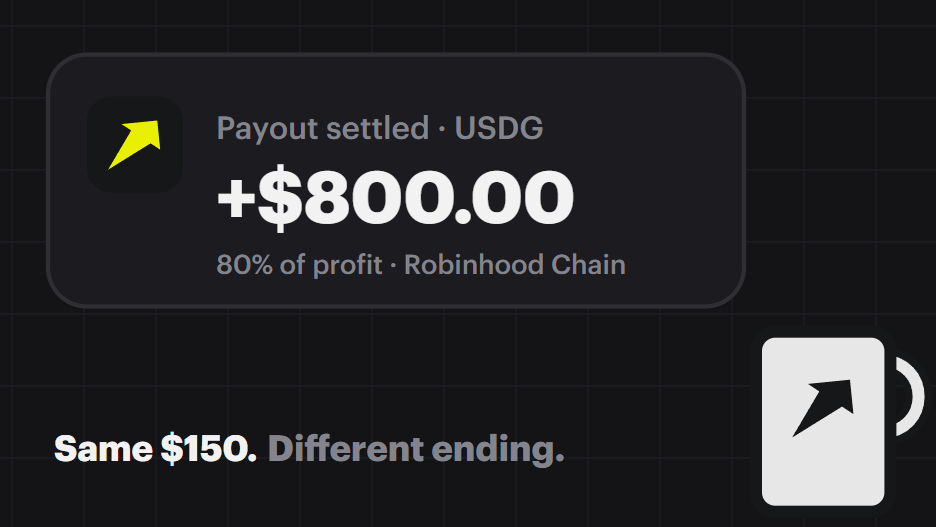
Payouts themselves are paid in USDG on Robinhood Chain, settled by smart contract, with no discretionary approval in between. They are paced at up to $800 per person per day, within a lifetime limit of 20% of the deployable reserve at the moment the account is funded: $4,000 at the recommended $25,000 seed.
On the same event, Dega reduces its own hedge exposure. Those hedge positions are Dega's own, never yours. And you may buy a new assessment immediately. A breach ends an account, not a relationship.
The edge cases
| Situation | What happens |
|---|---|
| Both limits are touched in the same tick | The account breaches. The maximum drawdown is recorded, because it is the more severe. |
| Price gaps straight through the drawdown level | Positions close at the first available mark after the breach. The closing balance may sit below the floor. Because the account is simulated, this creates no obligation in either direction. |
| The price feed is stale or unavailable | Limit enforcement is suspended, and no breach may be recorded on stale data. Trading on that instrument is suspended until the feed recovers. |
If the price gaps past your floor, you do not owe the difference, and Dega owes you nothing for it either. The account is simulated, so the shortfall is nobody's debt.
The stale feed case is a promise in the other direction. You are never breached on a price Dega cannot stand behind.
How to dispute a breach
You have 14 days to dispute a breach. Dega then produces three things: the tick, the limit and the calculation.
If the record does not support the breach, the account is reinstated.
So a dispute is not an appeal to anyone's judgement. It is a check of the record against the written rule. Did equity, including floating profit and loss, touch the daily limit or the static floor at that tick, on a price Dega can stand behind?
Why the record matters
Most traders fail. The paper says so plainly, and it names the incentive that creates: a firm earning most of its revenue from traders who fail has an incentive to make failure likely. A breach is the moment an account stops being able to earn, so it has to be something Dega can show, not just assert.
That is built into the plan. Before any paid user, the first launch gate requires the risk engine to enforce every limit exactly as written, with adversarial testing on breach timing, the daily reset, floating profit and loss, gaps and reconnection. Engineering is accountable for breach accuracy. The ledger keeps an immutable journal of financial changes, and replay must reproduce the financial effects.
The wick at the top of this post would breach the account. If it happened, the record shows it. If the record does not, the account comes back.
Nothing has launched. Every figure in this post is a design figure from the Dega yellow paper, version 2.0, dated 22 September 2026. Dega is not an exchange, broker, custodian or investment manager. Accounts are simulated: orders do not reach Lighter's order book, and the account balance is not your money. Dega's hedge positions are Dega's own, never yours. Payouts are subject to a lifetime limit of 20% of the publicly visible reserve and a per-user cap of $800 a day.