Contents
Your equity reads above $11,000. On a $10,000 account, that is the 10% target. One ETH position is still open. Have you passed?
Not yet. The target counts closed balance, not equity. Close the position with the balance at $11,000 or more and you pass. Let the move turn before you close and you have not.
Here is the whole assessment in order, from the fee to the last payout.
What you buy
You pay a one-time fee of $150 for a $10,000 simulated account. You pay in USDG from a wallet you control through a passkey, and payouts arrive in the same wallet.
The account is marked against Lighter's live perpetual futures prices, funding and conditions, on BTC and ETH, with up to 10x leverage. It is simulated. Your orders never reach Lighter's order book, and the $10,000 balance is not your money. It is a performance score, and it can never be withdrawn. What a simulated account means covers this in full.
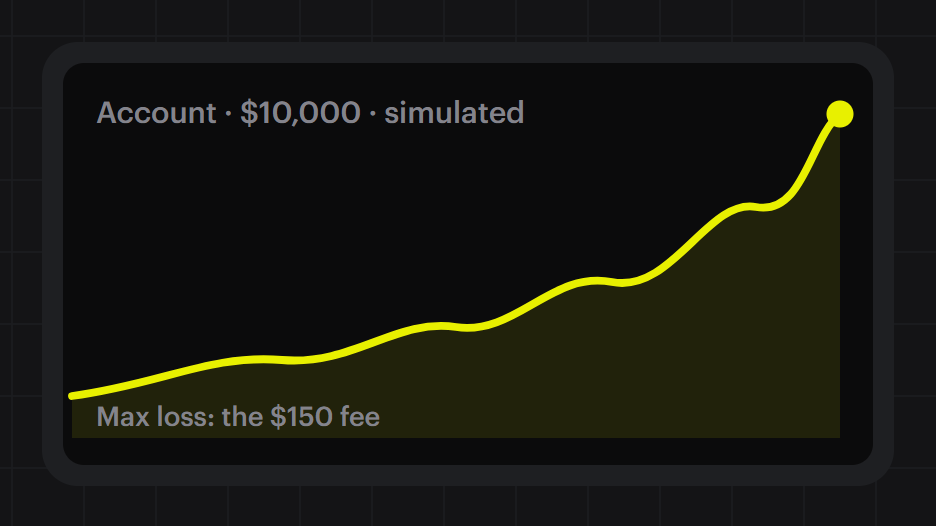
The fee is refundable in USDG until you activate the account. Once it is activated, the fee is not returned. That makes $150 the most you can lose, fixed before your first trade.
The three limits
| Rule | Setting | Measured on | Anchor | Reset |
|---|---|---|---|---|
| Profit target | 10% | Closed balance | Starting balance | None |
| Daily loss limit | 3% | Equity, including floating profit and loss | Balance at 00:00 UTC | Daily at 00:00 UTC |
| Maximum drawdown | 6%, static | Equity, including floating profit and loss | Starting balance | Never |
On a $10,000 account, you pass at a closed balance of $11,000. The static floor sits $600 below the start, at $9,400, and it never moves. The daily limit is measured from the balance at 00:00 UTC: on a day that opens at $10,000, it is $300.
The two bases are deliberate. Because the target counts closed balance, you cannot pass on an open position. Because both loss limits count equity, you cannot survive a limit by holding a losing position open. A limit breaches on a momentary touch, with no grace period and no end-of-day averaging.
There is no minimum number of trading days, no time limit and no consistency rule. Reach the target without a breach and you pass, whenever that happens.
Breach
Touch either loss limit and the account is disabled permanently, with no payout from the balance, including profit made before the breach. No breach can be recorded on a stale price feed. You can dispute a breach within 14 days, and Dega produces the tick, the limit and the calculation. You can also buy a new assessment straight away. A breach ends an account, not a relationship.
Passing and the funded stage
Passing pays nothing. Assessment profit is a score, and your first payable dollar is earned in the funded stage.
When you pass, a funded account opens, subject to capacity. No funded account is activated unless the payout reserve already covers it: $1,600 set aside, twice what a full profit cycle pays. It starts at the same $10,000, flat, with no position and no profit carried across. It has the same daily and static limits, measured the same way, and no profit target.
Funded accounts are still simulated. Dega hedges its overall payout obligation with real positions on Lighter, and those positions are Dega's own, never yours.
Payouts
You can take a payout whenever the funded account is in profit against its starting balance and flat, with no open positions and no open orders.
Payout = (current balance minus starting balance) x 80%
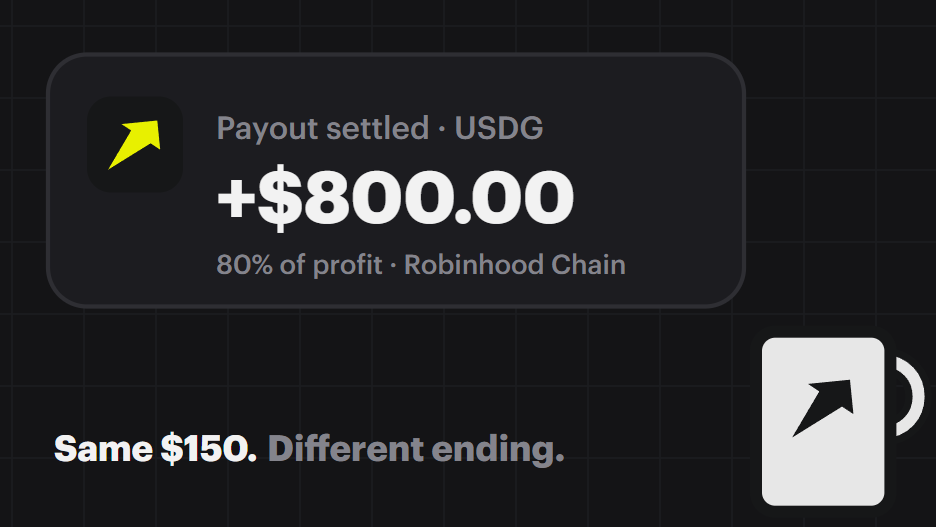
A full 10% cycle on $10,000 is $1,000 of profit, so $800 to you. There is no minimum wait, no minimum amount and no approval queue. Payouts are paid in USDG on Robinhood Chain and settled by smart contract, with no discretionary approval in between. Dega pays the gas. The payout rules name one withholding condition, where sanctions or restricted-jurisdiction rules require it, and nothing else.
After a payout, the balance returns to the starting balance and the drawdown floor stays where it was. The full reduction is added back to that day's loss budget, so taking profit never eats into the day's trading allowance.
- Per-person daily cap: $800, or your remaining lifetime limit if that is lower. Above the cap, the balance still returns to the start and the rest becomes a pending claim, held outside the account. It settles on the following days and cannot be traded or lost to a later breach.
- Global daily cap: 20% of the deployable reserve. Pending claims settle in the order they were created, before new requests.
- Lifetime limit: 20% of the deployable reserve at the moment the account is funded, $4,000 at the recommended $25,000 seed. It is fixed at funding, never decreases, and is recalculated upward at the next daily solvency check if the reserve grows.
Caps pace payment. They never reduce what is owed. Profit above the lifetime limit is not payable, which is why the remaining limit and any pending claim are shown in the account at all times.
From purchase to completion
| State | What it means | What comes next |
|---|---|---|
| Purchased | Fee paid, account not yet opened. Refundable in USDG until activation. | Activation |
| Active | The assessment is running. Limits are enforced continuously. | Passed or Breached |
| Passed | Target reached without a breach. Pays nothing. | Funded, subject to capacity |
| Funded | Live under the same limits. 80% of profit withdrawable. | Completed or Breached |
| Completed | Lifetime payout limit reached, or 90 days without a closed trade. Closes in good standing. | You may buy again |
| Breached | A limit was touched. Disabled permanently, no payout from the balance. | You may buy again straight away |
Some edges: a withdrawal larger than your remaining lifetime limit is paid up to the limit, not refused, and the account then Completes. A pending claim survives Completion. It is also paid in full if the funded account breaches while it is outstanding, because it left the trading balance while you were flat and eligible. An account that sits idle for 90 days closes without a refund of the fee, though profit already earned on a funded account stays withdrawable for a further 30 days.
What you can hold at once
- One assessment at a time.
- One funded account at a time.
- One assessment and one funded account together. If that assessment passes, its funded account waits until the current one closes.
- A new assessment straight after a breach or a Completion.
Reserve capacity is the constraint. Parallel attempts at one target multiply exposure to one trader's luck, and no trader should be an unacceptable share of what Dega owes. Account sharing and false registration are prohibited conduct.
One fee, three limits, and payouts settled by smart contract.
Nothing has launched. Every figure in this post is a design figure from the Dega yellow paper, version 2.0, dated 22 September 2026. Dega is not an exchange, broker, custodian or investment manager. Accounts are simulated: orders do not reach Lighter's order book, and the account balance is not your money. Dega's hedge positions are Dega's own, never yours. Payouts are subject to a lifetime limit of 20% of the publicly visible reserve and a per-user cap of $800 a day.