Contents
You buy an assessment, trade it for a while, and then step away. Work gets busy. Weeks turn into months, and the account sits open with nothing closing in it.
Dega has no time limit on reaching the target. It does have an idle rule, and it is worth knowing before you step away.
The rule
An assessment or a funded account that sits idle for 90 days closes. In the paper's account lifecycle, the measure is 90 days without a closed trade.
This is not a deadline. There is no time limit and no minimum number of trading days, so you can take as long as you need to reach the 10% target. The idle rule is narrower. It only closes an account in which no trade has closed for 90 days.
An idle closure is not a breach, because no limit was touched. On a funded account, the lifecycle records it as Completed, the same state as reaching the lifetime payout limit. A Completed account closes in good standing, and you may buy again.
What happens to the fee
The fee is not refunded. The $150 is refundable in USDG only while the account is purchased and not yet activated. Once it is activated, the fee is not returned, and closing for inactivity does not change that.
Every fee, net of gas, goes into the payout reserve when it is received. That reserve is held in USDG on Robinhood Chain, where anyone can see it. Why the reserve is public covers what it backs.
What happens to earned profit
On a funded account, profit already earned stays withdrawable for a further 30 days after the account closes. A pending payout claim also survives Completion and settles on the normal schedule.
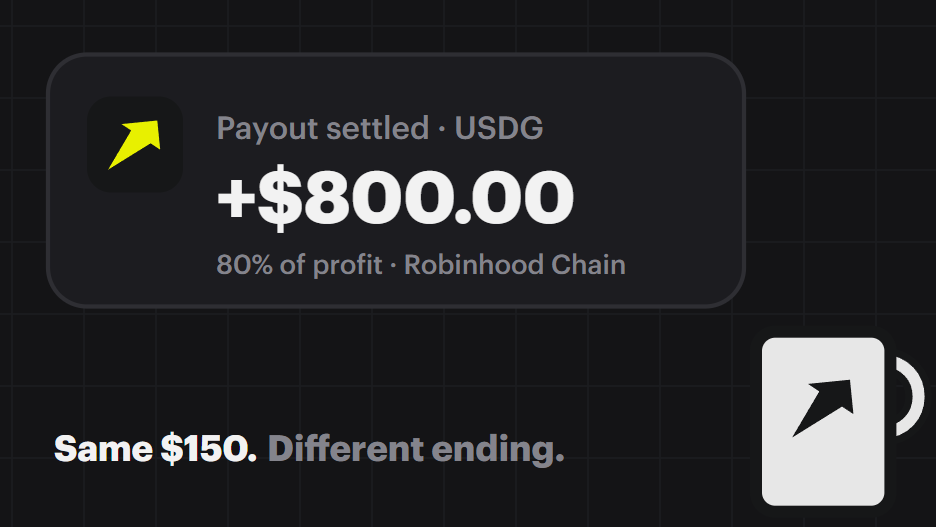
For reference, a payout is 80% of profit above the starting balance, paid in USDG on Robinhood Chain and settled by smart contract, with no discretionary approval in between. Payouts are paced at up to $800 per person per day, within a lifetime limit of 20% of the deployable reserve at the moment the account is funded: $4,000 at the recommended $25,000 seed.
Why the rule exists
The paper does not argue for the 90-day rule on its own. What it does make clear is that an open account is not free to carry, whether or not anyone is trading it.
Capacity is set by the reserve and counted in accounts. Each funded account reserves twice its liability, which is $1,600 on a $10,000 account. At the recommended $25,000 seed, the reserve carries 12 concurrent funded accounts and permits 76 live assessments, and a passed account is funded subject to that capacity. The paper also lists assessment duration as not yet measured, and notes that it sets how many assessments are open at once, and so how much reserve is needed.
In the record, Completed is kept separate from Breached. A funded account that goes quiet is filed with the accounts that finished, not with the ones that touched a limit.
If you know you are stepping away, the practical points are short: the clock runs on closed trades, and earned profit has 30 days after closure to come out.
Nothing has launched. Every figure in this post is a design figure from the Dega yellow paper, version 2.0, dated 22 September 2026. Dega is not an exchange, broker, custodian or investment manager. Accounts are simulated: orders do not reach Lighter's order book, and the account balance is not your money. Dega's hedge positions are Dega's own, never yours. Payouts are subject to a lifetime limit of 20% of the publicly visible reserve and a per-user cap of $800 a day.