Contents
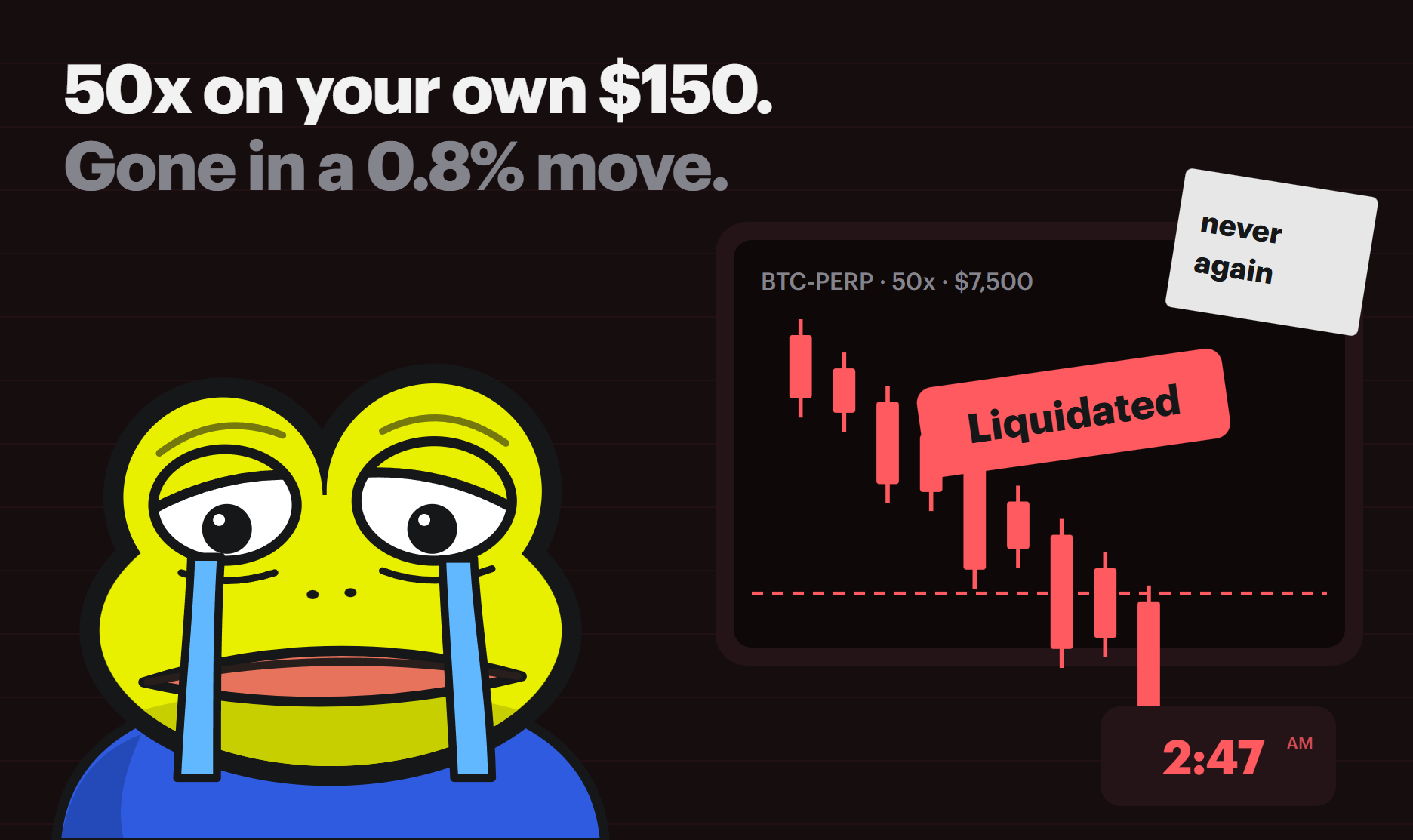
You know this one. It is 2:47 a.m. You have $150 on the exchange and a setup you are sure about, so you go 50x. That is a $7,500 position on your $150.
At 50x, a 0.8% move against you is enough. Not a crash, not news. Just an ordinary wiggle on BTC. The position closes, the $150 is gone, and you write "never again" on a sticky note you will ignore by Friday.
The trade idea was not the problem. The size was. With $150, the only way to trade real size is leverage, and leverage turns ordinary volatility into the end of the trade.
The same $150, spent differently
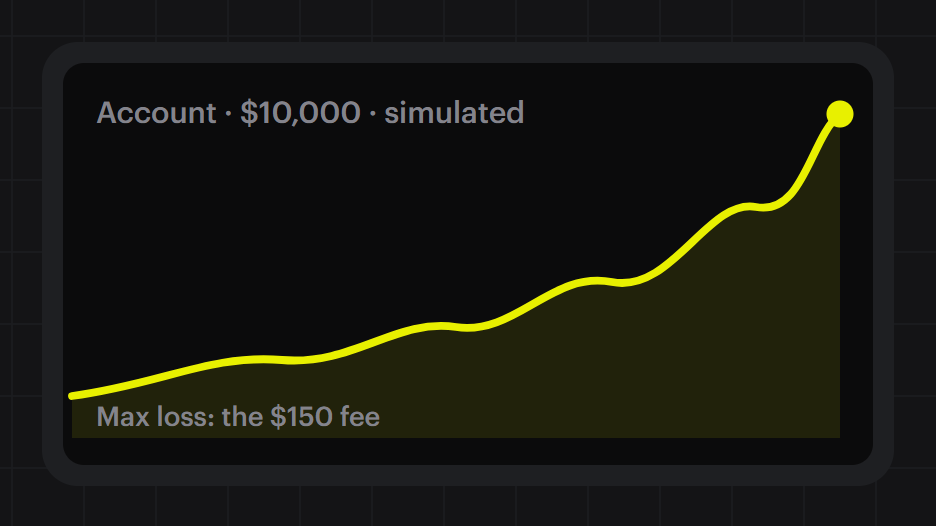
On Dega, $150 buys an assessment: a $10,000 simulated account priced on Lighter's live perpetual futures for BTC and ETH.
That is size you cannot reach with leverage. Matching a $10,000 position with $150 would take 66.7x, and Lighter's maximum on BTC and ETH is 50x. On the assessment you trade $10,000 without borrowing your way there, with up to 10x inside the account if you want it.
And the fee is the most you can lose. It is fixed before your first trade, whatever the market does afterwards. A bad day ends an account, not your savings.
The yellow paper's model puts the difference plainly: at the venue maximum, a $150 position ends in nine sessions out of ten on ordinary volatility. On the assessment, the same $150 ends in roughly one in three.
Three limits, and nothing else
| Rule | Limit | Measured on |
|---|---|---|
| Profit target | 10% | Closed balance |
| Daily loss limit | 3% | Equity, resets at 00:00 UTC |
| Maximum drawdown | 6% | Equity, static from the start |
Hit the target without touching either loss limit and you pass. There is no minimum number of trading days, no time limit and no consistency rule. Hit 10% on day one and you pass on day one.
Is the account real? No. The payouts are.
Once you pass, you get a funded account at the same $10,000 size, with the same daily and static limits and no profit target. Your orders are still simulated: they never reach Lighter's order book, and the balance is not your money.
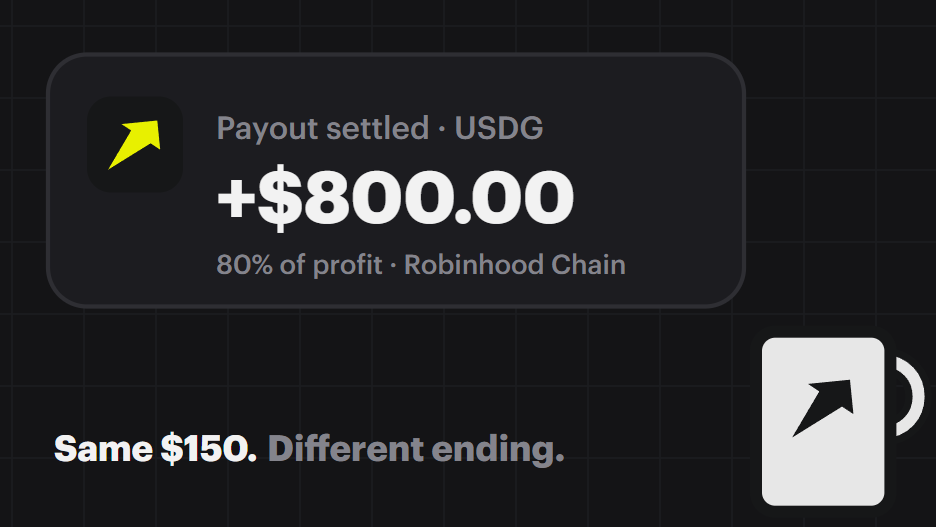
The payouts are real. When the funded account is in profit and flat, you can withdraw 80% of the profit above the starting balance. Payouts are paid in USDG on Robinhood Chain and settled by smart contract, with no discretionary approval in between. Dega pays the gas.
- Up to $800 per person per day. Anything above that becomes a pending claim and settles on the following days, in order.
- A lifetime limit of 20% of the deployable reserve when your account is funded: $4,000 at the recommended $25,000 seed.
- The USDG reserve that backs payouts is held on Robinhood Chain, where anyone can see it.
Why this can work
Most prop firms earn when traders fail. Every trader who passes is a cost they have to cover, so they add minimum days and consistency rules to keep pass rates down.
Dega hedges its total payout obligation with its own real positions on Lighter. Those positions are Dega's own, never yours. Because the payouts are funded, the pass rate can be whatever the rules produce, and the rules can stay this short.
Where this goes
The yellow paper's mission is to bring the capabilities of a trading firm within reach of individual traders, and to spread the cost of that infrastructure across a shared platform.
It comes with a commitment, written into the paper as policy: as the platform grows, the price falls and the limits rise. A bigger book offsets more of itself, the hedge per account gets cheaper, and that goes back to traders as a lower fee and a higher ceiling.
The 2:47 a.m. trade will still be tempting. The difference is what it can cost you.
Nothing has launched. Every figure in this post is a design figure from the Dega yellow paper, version 2.0, dated 22 September 2026. Dega is not an exchange, broker, custodian or investment manager. Accounts are simulated: orders do not reach Lighter's order book, and the account balance is not your money. Dega's hedge positions are Dega's own, never yours. Payouts are subject to a lifetime limit of 20% of the publicly visible reserve and a per-user cap of $800 a day.