Contents
You buy BTC at market. The order fills, the position appears, and your equity moves with Lighter's live price. It feels like a trade on Lighter. It is not one.
Your order never reached Lighter's order book. The position exists inside your Dega account, marked against Lighter's live market, and nowhere else. That is what simulated means.
What the account is
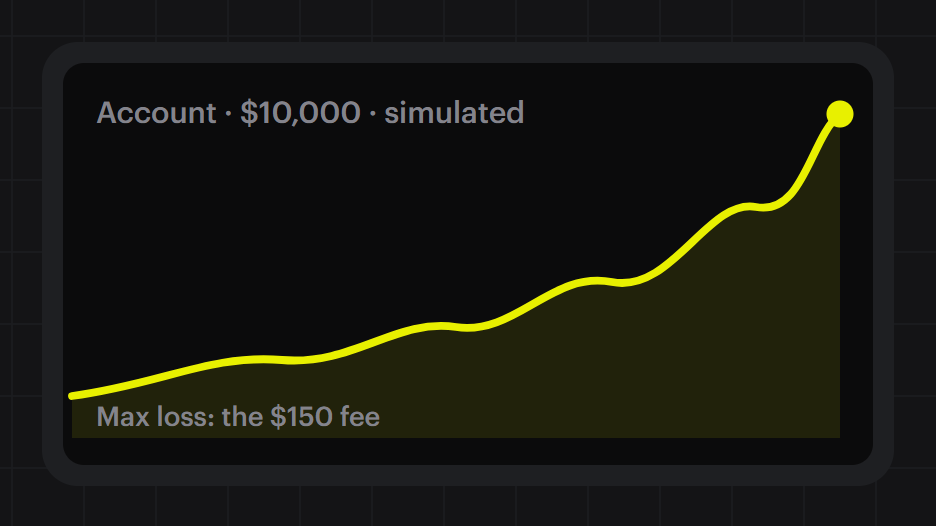
A Dega account is a performance-tracking mechanism. It is marked against Lighter's live prices, funding and conditions, but it is not a position on a public venue, and you do not own it.
The $10,000 balance is notional: a score of how you trade, not your money, and never withdrawable. That stays true after you pass: a funded account is simulated too.
This is the category norm, not a compromise. The yellow paper checked other firms against their own disclosures, and every one of them is simulated. Dega says so plainly, which the paper calls its single most important disclosure decision.
What is real
The paper keeps three ledgers apart. Only two of them hold real money.
| Ledger | What it holds | What it is never |
|---|---|---|
| Simulated account | A notional balance marked against live Lighter prices, funding and conditions. A performance score. | Your cash, or any amount you can withdraw |
| USDG reserve | Assessment fees in, payouts out. Held on Robinhood Chain and publicly visible. | Margin for the hedge, or a source of operating costs |
| House trading account | Dega's own money, funding the hedge. Kept separate permanently. | A source of payouts, or funded from the reserve |
Your USDG sits in a wallet you control through a passkey, and Dega does not hold it. You pay the $150 fee from that wallet, and payouts come back to it in USDG, settled by smart contract, with no discretionary approval in between. They are capped at $800 per person per day, within a lifetime limit of 20% of the deployable reserve at the moment the account is funded: $4,000 at the recommended $25,000 seed.
The reserve backs payouts, not notional balances. Twelve funded $10,000 accounts are $120,000 of notional balance, but at one full profit cycle each they are $9,600 of liability. More in Why the reserve is public.
Where the hedge fits
Dega does hold real positions on Lighter. It hedges its overall payout obligation across funded accounts, sized to what it owes across the book, not matched to each trader's position. Those positions are Dega's own, taken against its own obligation, and never your position.
Two rules keep that line clean. Assessment-stage orders are never hedged, so the assessment stays a clean measurement of your trading. And a failed hedge never reverses a simulated fill: once a fill is committed in your account, it is final. If Dega cannot open its own position, that is Dega's problem, never yours.
Simulated has to mean realistic
A simulation is only fair if it behaves like the market. Funding is applied as Lighter applies it, slippage and spread are simulated by size, and liquidation costs up to 1%, as it does on Lighter. Markets at launch are BTC and ETH, because depth is what makes a simulated fill honest. Fees and slippage on a simulated account has the detail.
It also means you are never breached on a price Dega cannot stand behind. If the price feed is stale or unavailable, limit enforcement and trading on that instrument are suspended until it recovers, and no breach can be recorded on stale data. If price gaps straight through your drawdown level, positions close at the first available mark. A closing balance below the floor creates no obligation in either direction, because the account is simulated.
The rule runs both ways. Exploiting platform errors, latency or pricing anomalies in the simulation is prohibited, and so are strategies that could not be repeated in live markets at the same size.
Why it gets said so often
In August 2023, a United States regulator charged what was then the largest retail prop firm in the world with fraud. The theory of harm was misrepresentation: the firm marketed itself as putting traders in real markets, when most funded accounts were simulated.
So Dega says it every time. Your account is a score. The fee and the payouts are real USDG. The hedge is Dega's own.
Nothing has launched. Every figure in this post is a design figure from the Dega yellow paper, version 2.0, dated 22 September 2026. Dega is not an exchange, broker, custodian or investment manager. Accounts are simulated: orders do not reach Lighter's order book, and the account balance is not your money. Dega's hedge positions are Dega's own, never yours. Payouts are subject to a lifetime limit of 20% of the publicly visible reserve and a per-user cap of $800 a day.