Contents
One other firm sells the identical rule set, a 10% target against a 6% static drawdown on $10,000, for $85. Dega charges $150. If you are comparing checkouts, that is the first thing you notice.
The price was not set against anyone's checkout. It comes from two questions: what the fee does for you, and what it has to cover.
What the fee does for you
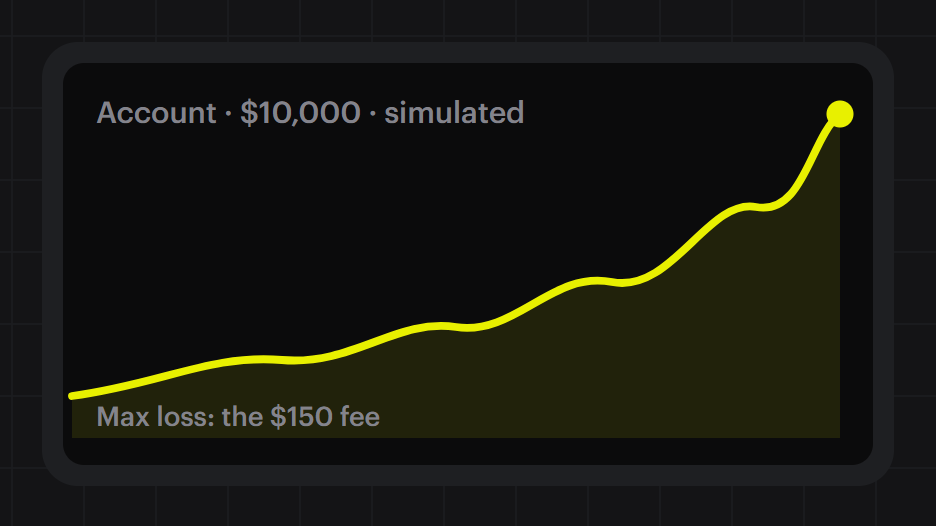
$150 is the most you can lose, fixed before your first trade, whatever the market does afterwards.
With your own money, the amount that sets the size of a result is the same amount that absorbs a loss. A $10,000 base needs $10,000 at risk. The assessment splits the two: the fee sets the loss, and the $10,000 notional balance sets the size of the result. That balance is simulated, and it is not your money.
It also works if you have the money and would rather not tie it up. An assessment costs 1.50% of the notional it controls. At 5% a year, $10,000 held as idle margin gives up $500, 3.3 times the fee. You pay $150 once, keep $9,850 working elsewhere and trade the same size.
What the fee has to cover
Every fee, net of gas, goes into the payout reserve on receipt. No payout is made from anywhere else. Payouts are USDG, settled by smart contract, with no discretionary approval in between, up to $800 per person per day and within a lifetime limit of 20% of the deployable reserve at the moment the account is funded, $4,000 at the recommended $25,000 seed.
| Line | $10,000 account |
|---|---|
| Assessment fee | $150 |
| Into the payout reserve, after gas | $149.50 |
| Design pass rate | 15.6% |
| Expected payout per funded account | $480 |
| Expected payout per sale | $74.88 |
| Contribution per sale | $74.62 |
The 15.6% is not a Dega result. Nothing has launched, so it is a comparable firm's verified pass rate at $10,000, captured on 22 September 2026. The $480 comes from the rules: a full profit cycle pays $800, and against a 10% target and a 6% floor a funded trader is expected to complete 0.6 cycles before the floor. 0.6 x $800 is $480.
The test that set the price
Planning on $480 works because Dega's hedge, its own positions on Lighter and never yours, bounds the worst case. The price had to survive that failing: the hedge delivers nothing, and every funded account costs a full $800 cycle.
| Fee | Break-even pass rate | Contribution, planning basis | Contribution, hedge delivers nothing |
|---|---|---|---|
| $85 | 10.6% | $9.62 | -$40.30 |
| $115 | 14.3% | $39.62 | -$10.30 |
| $150 | 18.7% | $74.62 | $24.70 |
| $175 | 21.8% | $99.62 | $49.70 |
At $150 the fee still clears $24.70 a sale with no help from the hedge. At $115 and $85 it goes negative. A price that only works when everything works is not a price. Every other firm in the category is subsidised by something Dega does not have yet: an exchange parent, a venture round or an established book. Dega has to be solvent on its own terms from the first sale.
The honest part, and when it falls
The expected value of an assessment to the trader is negative: -$75.12 at the design pass rate. Every firm in this category sells the same thing. An assessment is bought for the shape of the outcome rather than its average, the way an option premium is. Dega's answer is to publish the realised pass rate accurately, so you decide with the real number in front of you.
$150 is also not permanent. The fee is tied to a measured trigger: revenue per funded trader from sources other than the fee, which the paper calls levers. None is live at launch.
| Lever revenue per funded trader | Break-even fee | Status |
|---|---|---|
| $0 | $75.38 | Launch |
| $240 | $37.94 | Half the crossover |
| $480 | $0.50 | Crossover |
The fee falls when measured lever revenue clears a stated threshold, and the lifetime payout limit rises on the same basis. Both are recorded at the daily solvency check and published. Neither moves on judgement. Cutting a price later reads as generous, and raising one reads as predatory, so $150 is where it starts.
Nothing has launched. Every figure in this post is a design figure from the Dega yellow paper, version 2.0, dated 22 September 2026. Dega is not an exchange, broker, custodian or investment manager. Accounts are simulated: orders do not reach Lighter's order book, and the account balance is not your money. Dega's hedge positions are Dega's own, never yours. Payouts are subject to a lifetime limit of 20% of the publicly visible reserve and a per-user cap of $800 a day.